
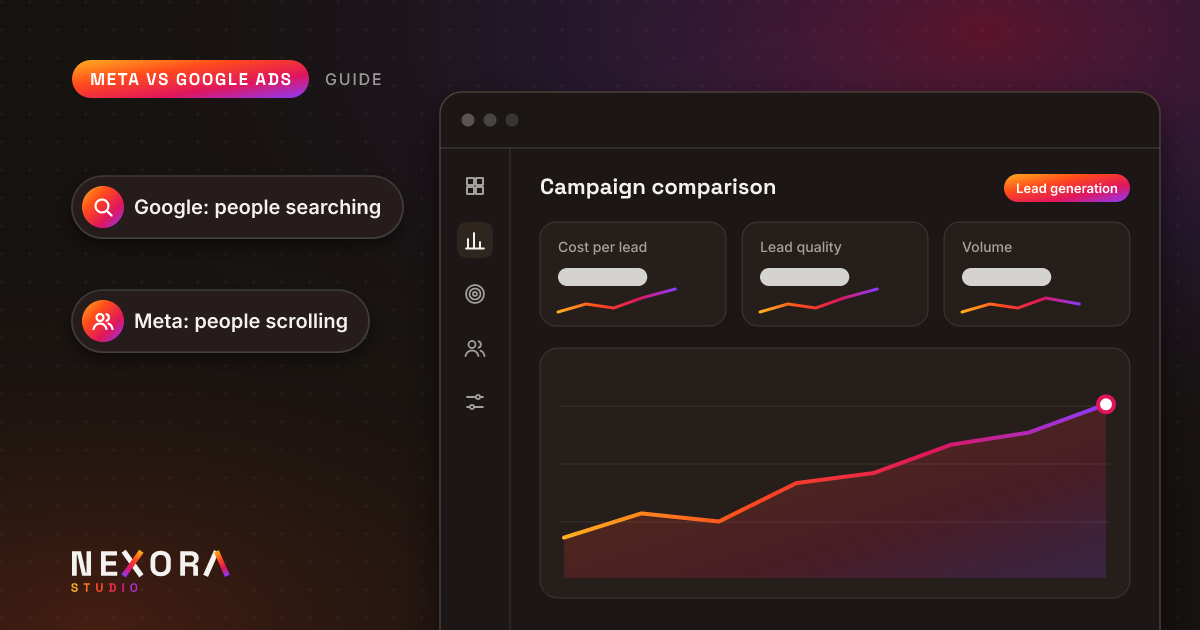
Google Ads shows your ad when someone searches a term related to what you sell. The person is already looking. Your job is to be there with a relevant ad and a landing page that answers the exact search.
Meta Ads (Instagram and Facebook) shows your ad while someone is scrolling a feed for something else entirely. Nobody searched for you. Your job is to interrupt that scroll with something that catches attention and gives a reason to act, using targeting based on interests, behaviour and who is similar to your existing customers.
This difference affects almost everything else: the kind of lead you get, how fast they are ready to buy, and what your ad and landing page need to do.
How the two platforms work
Google Ads tends to work well when demand already exists and people type a recognisable search for it — a service, a repair, a specific product, "near me" searches, or a competitor's name.
It also suits businesses that can respond to an enquiry quickly. A search lead is often comparing two or three options right now, so a slow reply loses them to whoever answers first.
Signs Google Ads fits your business
Meta Ads tends to work well when your product or service is visual, impulse-friendly, or not something people actively search for yet — a new product, a lifestyle offer, a course, an event, or a business building awareness in a new area.
On Google Ads, cost per click is driven mainly by how many advertisers bid on the same search terms. Competitive terms (insurance, loans, legal services) can be expensive; a specific, local or less-competed term can be much cheaper.
On Meta Ads, cost is driven by the size and overlap of your target audience and how well your ad performs with it. A narrow, low-performing audience can get expensive fast; a broader audience with a strong ad often costs less per result, which is the opposite of how many people expect it to work.
Neither platform has a fixed "normal" cost per lead — it depends on your industry, location and how tightly you target, so treat any number you hear from someone else's business as a rough reference, not a benchmark for yours.
Google Ads needs the right keywords and a landing page that matches the search term closely — see our landing page checklist before you spend on either platform. A mismatch between the ad's promise and the page is one of the most common reasons search campaigns underperform.
Meta Ads needs creative that works while scrolling: a clear image or short video, a headline that states the benefit, and a reason to act now. The same offer with weak creative on Meta will usually underperform, even with good targeting.
Cost per lead is easy to see and easy to misread. A cheap lead that never answers the phone is worse than a more expensive one that converts. Before comparing the two platforms, make sure conversion tracking is actually set up correctly — see our guide on what a small business website needs for the basics, and consider a growth audit if you are not confident the numbers are accurate.
At minimum, track lead volume, cost per lead, and the share of leads that turn into paying customers, by platform. Without the third number, you are only comparing how cheap the leads are, not how good they are.
Yes, and many end up doing so, but usually not on day one. A common sequence is to start with the platform that matches an existing, clear search demand, get tracking and follow-up right, then add the second platform once there is a process to handle more leads.
Running both badly, with no clear tracking on either, usually costs more than running one platform well. If budget is limited, pick one channel first, run it properly for a few weeks, and only add the second once you can see where every rupee of the first one goes.
Ask three questions:
If the answers point in different directions, start with whichever channel matches your current ability to follow up, not the one with the lowest advertised cost per click.
Neither is reliably cheaper — it depends on your industry, location, targeting and how well your landing page or creative performs. Compare the two for your own business over a few weeks rather than relying on a general number.
No, but testing both at once with a very small budget on each usually gives too little data to judge either fairly. It is often better to run one platform properly first, then test the second.
It can, particularly where the service photographs or films well, or where a short video can explain the benefit. It usually needs more follow-up after the lead arrives than a search lead does.
You can, but a page written to match a specific search term often outperforms a generic page for Google Ads, and a page built to continue the story from the ad creative usually performs better for Meta Ads.
Not sure which platform fits your business, or whether your current campaigns are tracked correctly? Read about our paid media work or tell us what you are trying to achieve and we will help you decide.